Why Pneumatic Still Wins for High-Volume Framing and Trim
Cordless nailers have gotten good, but for the sheer volume of nails a barndominium build goes through — framing interior partitions, hanging trim through an entire living-quarters finish phase — pneumatic still wins on cost per tool and power per dollar. No batteries to keep charged across a job site, no dead cells halfway through a wall. The tradeoff is a compressor and a hose, which is a real limitation, not a footnote (more on that below).
Framing Nailer: What It's For
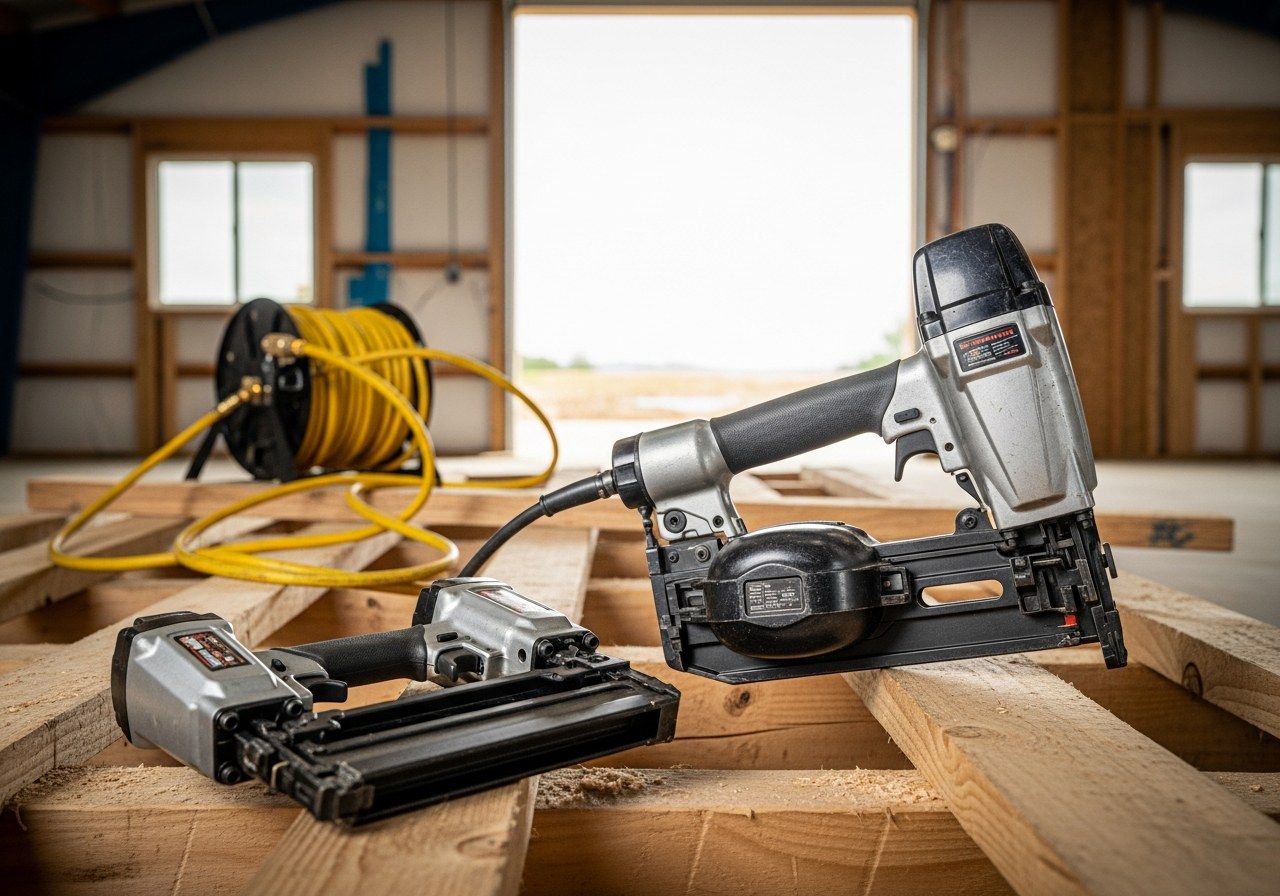
A pneumatic framing nailer drives full-size framing nails fast enough to keep pace with a crew — interior partition walls (especially the wall separating a shop bay from living quarters), blocking, and any stick-framed sections of an otherwise post-frame build. Look for adjustable depth-of-drive so you're not chasing over-set or proud nails across a whole wall, and confirm the magazine's collation angle (21°, 28°, 30-34° paper or plastic strip) matches what your local supplier actually stocks — angle and collation type aren't interchangeable between nailer brands.
Finish Nailer: What It's For
A 15- or 16-gauge finish nailer handles baseboard, casing, and trim during the interior finish phase — thin enough gauge to leave a small hole that fills easily, strong enough to hold trim tight without pre-drilling. This is the tool that shows up last on a barndominium build, once framing, mechanical rough-in, and drywall are behind you and the living-quarters side starts looking like a finished home.
What a Pneumatic Setup Actually Requires
Beyond the nailer itself: an air compressor sized for the tool's CFM draw, a hose long enough to actually reach your work (or a retractable hose reel mounted centrally in the shop bay), and the right fittings. If you're piping compressed air to fixed drop locations around a shop instead of dragging a hose off a portable compressor, that's a separate planning decision worth making before walls close in — see the shop-utilities section of /gear for the aluminum tubing systems built for exactly that.
Where This Shows Up on a Barndominium Build
- Interior partition framing — the wall(s) separating shop space from living quarters, plus any stick-framed interior walls inside an otherwise post-frame shell.
- Blocking and backing — for cabinets, grab bars, and wall-mounted fixtures before drywall goes up.
- Trim and casing — baseboard, door and window casing, and soffit/fascia trim during the finish phase.
What to Check Before You Buy
- PSI and CFM range: match the tool's stated operating range to your actual compressor, not just the tool's max rating — an undersized compressor will bog down mid-wall.
- Collation and angle: confirm the nail strip angle and gauge match what's actually available locally before you're mid-project and can't find nails.
- Depth-of-drive adjustment: tool-free adjustment saves real time when you're switching between softwood framing and denser trim material in the same day.
One Honest Limitation
A pneumatic setup ties you to a compressor and a hose — genuinely awkward solo work in a large open shop bay where you're moving around a lot, compared to a cordless nailer's total freedom of movement. If most of your work is framing and trim in a fixed area, pneumatic's cost and power advantage wins easily. If you're working alone across a wide-open 60- or 80-foot shop bay, factor hose length and reel placement into the decision, not just the tool price.
Where to Buy
Metabo HPT NR90ADS1 Pneumatic Framing Nailer on Amazon.ca
Metabo HPT NT65MA4 15-Gauge Finish Nailer on Amazon.ca
As an Amazon Associate, IronField earns from qualifying purchases — the price you pay doesn't change.
More shop-build gear lives in the full gear guide, and the checklist tracks what needs to happen before and after the finish phase.